How Reptiles See the World
Reptiles don't see the world the way we do. They perceive a far richer visual spectrum — including ultraviolet light invisible to humans. Understanding this helps explain why sunlight is so critical to their health and behavior, and why most indoor setups fall short.
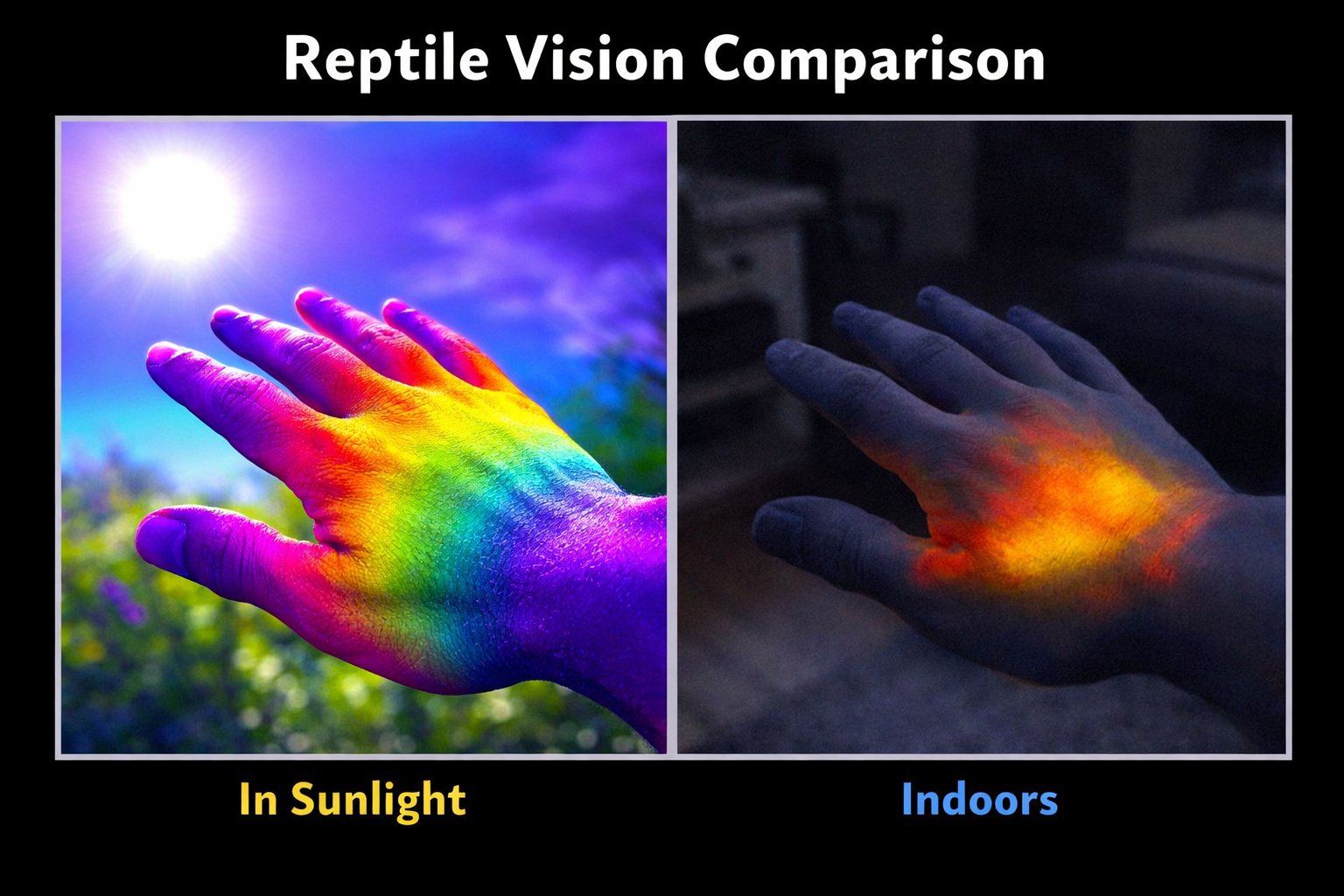
🌈 The Light Spectrum: What Reptiles Actually See
Human vision covers roughly 380–700 nanometers of the electromagnetic spectrum. Many reptiles extend well into the ultraviolet range, perceiving light down to approximately 300nm — a range completely invisible to us.
☀️ Sunlight vs. Indoor Lighting
The image at the top of this page illustrates the dramatic difference in how a reptile experiences these two environments. Outdoors in natural sunlight, the world is vivid and full of information. Indoors under standard lighting, that world becomes muted and visually impoverished.
The full electromagnetic spectrum is available — including UVA and UVB radiation that most reptiles depend on.
- Full UVA/UVB spectrum present
- Vivid, information-rich visual environment
- Enables UVB-driven vitamin D3 synthesis
- UV patterns on animals and food visible
- Natural circadian rhythm cues intact
- Correct color perception for finding food and mates
Standard incandescent, LED, and fluorescent bulbs emit little to no UV. Even "full spectrum" bulbs vary widely.
- UV largely absent or severely reduced
- World appears visually dull and incomplete
- D3 synthesis impaired without supplemental UVB
- UV markings on prey and conspecifics invisible
- Disrupted circadian and behavioral cues
- Color perception shifted — food may look unappetizing
🔬 UVA vs UVB — Two Different Roles
It's important to understand that UVA and UVB serve very different functions for reptiles, and both are missing from most indoor environments.
- Directly visible to reptiles as a color
- Used for social signaling and mate selection
- Helps identify food — many insects and plants reflect UV
- Regulates appetite, activity, and reproductive behavior
- Critical for psychological wellbeing
- Not directly visible — acts on skin
- Triggers vitamin D3 synthesis in the skin
- D3 is essential for calcium absorption
- Deficiency leads to metabolic bone disease (MBD)
- Cannot be fully replaced by dietary D3 alone in many species
⚠️ Real Consequences of UV Deprivation
| Effect | Cause | Common Species Affected |
|---|---|---|
| Metabolic Bone Disease (MBD) | UVB deficiency → impaired D3 synthesis → calcium deficiency | Bearded dragons, iguanas, chameleons, tortoises |
| Reduced appetite | UVA absence makes food appear different, less appetizing | Most diurnal species |
| Reproductive failure | UV cues critical for mate recognition and breeding triggers | Lizards, some snakes, turtles |
| Lethargy & stress | Incomplete sensory environment disrupts natural behaviors | All UV-dependent species |
| Immune suppression | D3 plays a role in immune function beyond just calcium | Tortoises, iguanas, bearded dragons |
| Eye problems | Some species may develop issues without proper UV stimulation | Chameleons, day geckos |
✅ What You Can Do
The goal is to replicate the full spectrum of natural sunlight as closely as possible. This requires deliberate choices about lighting — not just any bulb will do.
For indoor setups:
- Use a dedicated UVB bulb from a reputable brand — Zoo Med, Arcadia, or Exo Terra
- Choose the correct UVI (UV Index) for your specific species
- Replace UVB bulbs on schedule — output degrades before the bulb burns out
- Ensure nothing filters the UV between bulb and animal (no glass, most plastics)
- Position the basking spot at the correct distance per manufacturer specs
- Provide a meaningful photoperiod — 12–14 hours of light for most tropical species
🦎 Which Species Need UV Most
While all reptiles benefit from proper lighting, some have particularly high UV requirements and will suffer noticeably without it.