Red Devil vs Midas Cichlid — Telling Them Apart
Species guides, identification tips, and general care information.
🐠 Red Devil vs Midas Cichlid — Telling Them Apart
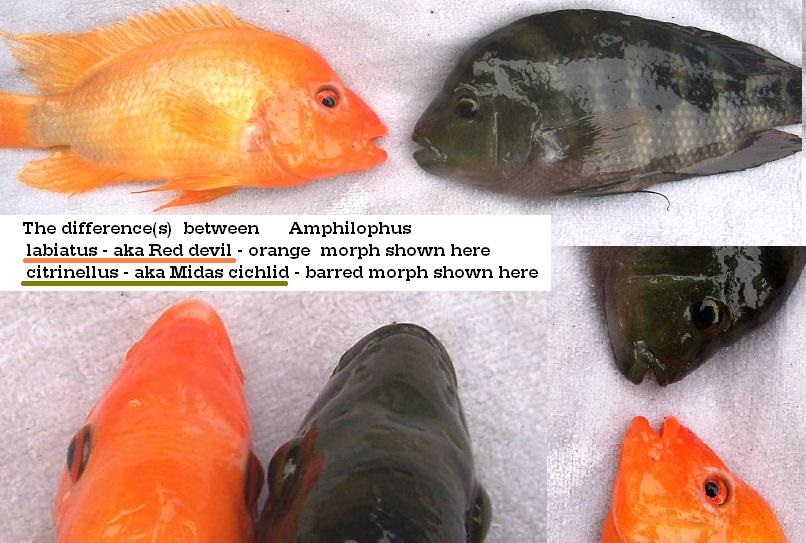
I have been asked several times over the years the difference between Red devils and Midas cichlids - here is a comparison photo of accurate representations of each. This picture was originally posted on a former website of mine.
Over the years red devils and midas in the hobby were hybridized commercially so it is safest to assume any unknown's are likely hybrids.
- Origin: Lake Managua and Lake Nicaragua, Nicaragua
- Size: Up to 15 inches (38 cm) — males typically larger
- Key ID feature: Large, fleshy, rubbery lips — particularly prominent in adults. The lips are the defining characteristic that separates labiatus from citrinellus in the wild.
- Body shape: More elongated and slender profile compared to the Midas
- Nuchal hump: Present in dominant males but typically less pronounced than in the Midas
- Color: Wild fish are dark brown/black with orange coloration developing with age. Captive-bred fish are often solid orange, red, or white due to selective breeding — similar to Midas
- Temperament: Extremely aggressive — one of the most aggressive Central American cichlids. Best kept alone or with very robust tankmates
- Tank size: 75 gallon minimum for one adult; 125+ for a pair
- Lifespan: 10–12 years in good care
- Origin: Lake Nicaragua, Lake Managua, and associated rivers
- Size: Up to 14 inches (35 cm) — similar to the Red Devil
- Key ID feature: Thinner, less rubbery lips than labiatus. The body tends to be deeper and more robust. Dominant males develop a very prominent nuchal hump (cranial bump) more reliably than the Red Devil.
- Body shape: Deeper, more laterally compressed body — stockier overall than labiatus
- Nuchal hump: Typically more pronounced and reliable than in the Red Devil — a large fatty hump on the forehead of dominant males
- Color: Wild fish are grey/brown with dark bars. Color morphs — orange, yellow, white — occur naturally in the wild at a higher rate than in most cichlids, which is why this species became the foundation for so many hybrid breeding programs
- Temperament: Highly aggressive — similar to the Red Devil. Not a community fish
- Tank size: 75 gallon minimum; 125+ preferred for adults
- Lifespan: 10–12 years in good care
Quick Identification Guide
When trying to tell the two species apart in the store or from photos, focus on these three features in order of reliability:
- Lips: Thick, fleshy, rubbery enlarged lips = almost certainly labiatus (Red Devil). Thin, normal lips = likely citrinellus (Midas) or a hybrid.
- Nuchal hump: A very large, pronounced cranial hump in a dominant male is more characteristic of the Midas — though both species develop humps.
- Body depth: The Midas has a noticeably deeper, rounder body profile. The Red Devil is more elongated and torpedo-shaped.
Color is not a reliable identification feature — both species produce the same range of orange, yellow, red, white colored and barred variants in captivity and in the wild.
General Care — Both Species
- Filtration: Heavy — these are large, messy fish with a significant bioload. Oversized filtration is strongly recommended. Canister filters or sump setups are ideal.
- Water changes: 25–30% weekly minimum to maintain water quality and reduce aggression.
- Substrate: Large gravel or bare bottom — both species will dig extensively and will uproot any plants. Decorate with large rocks and driftwood secured to the tank bottom.
- Diet: Omnivore. High-quality cichlid pellets as a staple. Supplement with earthworms, shrimp, and occasional vegetables. Avoid feeder fish — disease risk is not worth it.
- Tankmates: Very limited options due to extreme aggression. Other large, robust Central American cichlids may work in very large tanks with careful monitoring. Most keepers house them alone or as a single bonded pair.
🐟 General Cichlid & Fish Information
This section will expand over time with care guides, species profiles, and hobbyist tips for cichlids and other fish commonly kept and traded at exotic pet expos and in the community.
🌎 Central American Cichlids
Central American cichlids are among the largest and most aggressive cichlids in the hobby. Most require large tanks, robust filtration, and careful tankmate selection — or solo housing. They are rewarding fish that often develop strong personalities and can recognize their owners.
- Red Devil — Amphilophus labiatus
- Midas Cichlid — Amphilophus citrinellus
- Flowerhorn (hybrid)
- Jack Dempsey — Rocio octofasciata
- Jaguar Cichlid — Parachromis managuensis
- Green Terror — Andinoacara rivulatus
- Dovii / Wolf Cichlid — Parachromis dovii
🌍 South American Cichlids
South American cichlids range from the massive Peacock Bass to the popular and colorful Oscars, Severums, and Eartheaters. Many South American species are more community-compatible than their Central American cousins, though the larger species still require serious tank space.
- Oscar — Astronotus ocellatus
- Severum — Heros efasciatus
- Geophagus (Eartheaters) — various species
- Peacock Bass — Cichla species
- Pike Cichlid — Crenicichla species
- Discus — Symphysodon species
🐠 General Large Cichlid Care Tips
- Research adult size before buying: Many cichlids sold as juveniles at 2–3 inches will reach 12–18 inches as adults. Always research the full adult size of any cichlid before purchasing.
- Cycle your tank first: Never add large cichlids to an uncycled tank. The nitrogen cycle must be established before adding fish. A fully cycled tank has measurable nitrite and then nitrate, with ammonia at zero.
- Bigger is always better: When in doubt, go larger on tank size. Large cichlids produce significant waste and need the volume for stable water parameters and to reduce aggression.
- Secure your decorations: Large cichlids will move gravel, rearrange rocks, and uproot plants. Any rocks or decorations large enough to tip and crack the glass should be secured with aquarium-safe silicone.
- Don't trust the "inch per gallon" rule: This outdated rule does not apply to large, messy cichlids. A single adult Oscar or Red Devil needs a 75+ gallon tank — not 12–15 gallons.
- Feed quality food: High-quality pellets designed for carnivorous or omnivorous cichlids should be the staple diet. Avoid feeder goldfish — they carry disease and provide poor nutrition compared to prepared foods.